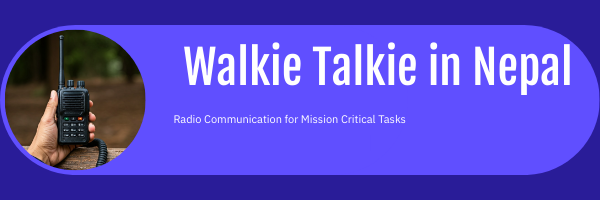
Walkie-Talkies for Critical Communication: Understanding Radio Communication in Nepal
In today's fast-moving environment, reliable communication is essential for organizations where teams need to coordinate quickly and efficiently. Walkie-talkies and professional two-way radio systems provide instant, group-based communication without depending on mobile networks. They are widely used in security, aviation, emergency response, government, industrial, and commercial operations.
🎮 Stage 1 Checkpoint: Core Advantage
Why are professional two-way radios essential during critical mission operations?
VHF (Very High Frequency)
Commonly used for wide outdoor coverage and open-area field operations, transport, and utilities.
UHF (Ultra High Frequency)
Optimal for urban, indoor, and obstructed settings like hotels, hospitals, construction, and security teams.
HF (High Frequency)
Delivers long-range communications beyond line-of-sight for remote zones, government, and aviation emergency needs.
Aviation Communication Framework
Operates on dedicated aeronautical frequencies (such as 121.5 MHz) governed by strict regulatory controls.
🎮 Stage 2 Checkpoint: Urban Deployment
Which frequency band is optimal for obstructed environments like concrete buildings and hotels?
In Nepal, radio communication is regulated, and organizations cannot simply purchase and operate professional radio equipment on any frequency of their choice. Under Nepal's radio communication licensing framework, radio equipment such as walkie-talkies and HF/VHF/UHF radio systems generally requires the appropriate licence for possession, use, production, or sale/distribution, subject to applicable exemptions.
Radio spectrum is a limited national resource. The Nepal Telecommunications Authority manages spectrum allocations, while the Department of Information and Broadcasting handles radio licensing under the Radio Act, 2014 and Radio Communication (Licence) Rules, 2049. Organizations must verify power levels, frequency allocations, and legal import compliance before deployment.
🎮 Stage 3 Checkpoint: Regulatory Framework
Which authority manages radio spectrum allocations across Nepal?
Who Needs Professional Systems
Primary Users: Security agencies, hotels, hospitals, factories, construction sites, airports, hydropower/infrastructure projects, and disaster response units.
How to Select Hardware
Selection Factors: Distance requirements, terrain, analog vs. digital modes, repeater installation, battery duty cycles, and legal frequency compliance.
🏆 Final Mastery Checkpoint
What parameters must be evaluated when architecting two-way radio networks for infrastructure projects?